Painting on Glass and Perspex
Materials, techniques, transparency, layering and experimental possibilities
Thursday evenings at Reynard Street Neighbourhood House in Coburg, exploring materials in Experimenting with Visual Art, facilitated by artist Sheena Mathieson, alongside an inspiring group of creatives, prompted a question: what happens when the surface is transparent?
Glass and Perspex offer rather different possibilities. The attraction isn’t simply painting on a transparent sheet: it’s painting through one, separating images into physical planes, suspending linework in space, or letting light and shadow become part of the composition. There’s also a long tradition of reverse painting, where the image is painted on the back and viewed through the front.
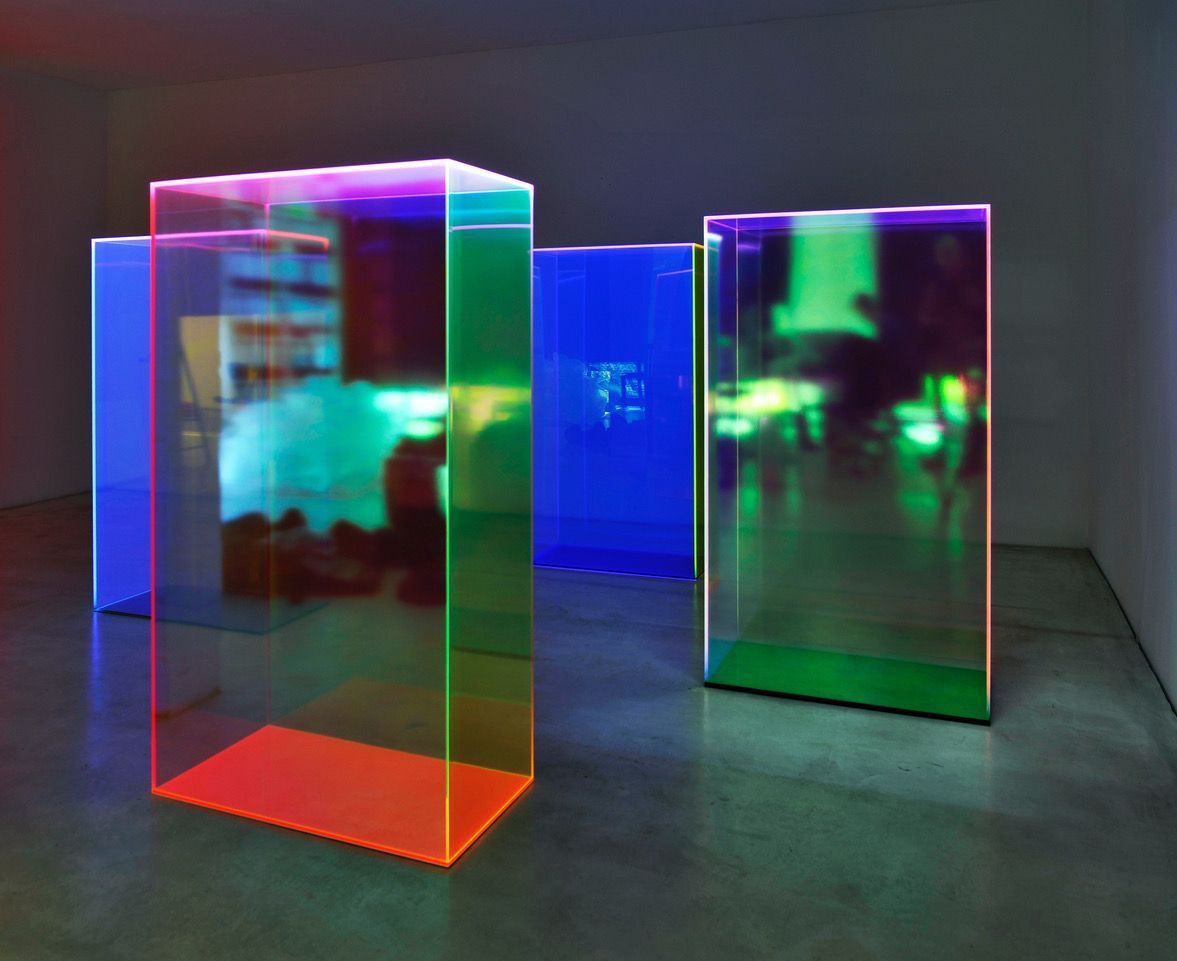
Regine Schumann, Lightcatcher (2017). Photograph by Eberhard Weible. Wikimedia Commons · CC BY-SA 4.0.

What becomes possible?
Four techniques are worth distinguishing:
- Reverse painting: detail goes behind a polished transparent face, which becomes the front of the picture.
- Layered Perspex: separated sheets create overlapping marks and physical depth.
- Transparent linework: the space beyond the drawing becomes part of it.
- Suspended painting: the work can cast another, shifting image onto a wall.
Glass versus Perspex
Perspex is a trade name for polymethyl methacrylate (PMMA), commonly called acrylic sheet. Despite the shared word acrylic, an acrylic paint and an acrylic sheet are different materials.
| Property | Glass | Perspex (PMMA) |
|---|---|---|
| Transparency | Excellent | Excellent |
| Weight | Heavy | Much lighter |
| Breakage | Brittle; can shatter | More impact-resistant, but can crack |
| Scratching | More resistant | Scratches more readily |
| Acrylic-paint adhesion | Often difficult; test a suitable medium | Often good on clean PMMA |
| Fine linework | Good with compatible ink or paint | Good with compatible ink or paint |
| Cutting | Requires specialist glass tools | Easier to fabricate |
| Long-term considerations | Stable support; paint bond remains an issue | Can scratch, warp or degrade |
| Multiple suspended layers | Possible, but heavy | Especially practical |
A little science. Ordinary soda–lime glass is an amorphous network built mainly from silicon and oxygen, with other elements modifying its structure. Perspex (PMMA) is a transparent plastic made from long carbon-based molecular chains. Both transmit visible light, but their surface chemistry and physical behaviour differ. Acrylic paint is pigment held in a polymer binder; as water evaporates, its dispersed binder particles coalesce into a film. The film’s adhesion depends on cleanliness, wetting, formulation and curing, not just on the material’s name.
GOLDEN Artist Colors advises that acrylic paint can adhere to cleaned PMMA without a ground, although it may need at least a couple of weeks to develop full adhesion. Glass presents a greater challenge, even with specialist media. GOLDEN: painting on acrylic sheeting · GOLDEN: painting on glass.
For small studies, clear cast Perspex about 3 mm thick is a practical starting point.
Four techniques worth exploring
A. Reverse painting. Paint on the back, then turn the sheet over. The order is reversed: foreground detail first, colour next, background last. Looking through the smooth sheet can give the image a sealed, luminous quality.
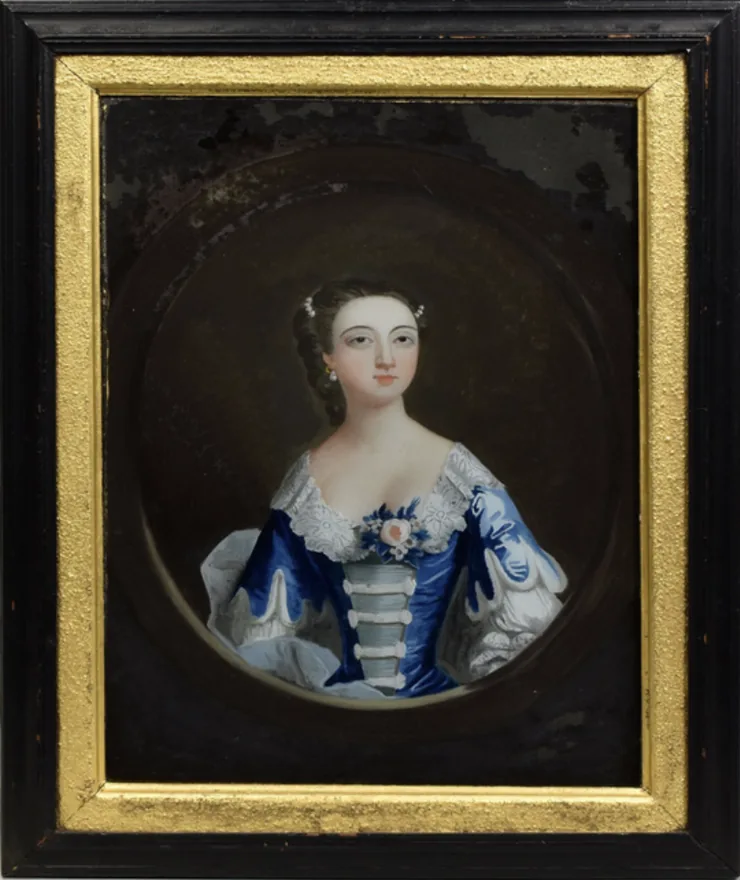
Elizabeth Gunning, c. 1750. Chinese export reverse-glass painting by an unidentified artist. Image resized and converted to WebP. Wikimedia Commons · Public domain.

B. Multiplane painting. Distribute lines, shapes and colours across two or more sheets separated by spacers. When the viewer moves, parallax changes how the layers line up.
C. Scratching and subtractive drawing. Cover part of the sheet with paint, then carefully remove lines or areas to reveal light. Marks can also be engraved directly into Perspex, but these are permanent.
D. Painting with shadows. Hold a painted sheet 20–50 mm from the wall. Directional light may create a second, displaced image behind it. The result depends on opacity, distance and the light source.
What paints and inks actually work?
| Medium | Glass | Perspex |
|---|---|---|
| Artist acrylic paint | Try GAC 200 or a compatible glass medium | Excellent starting point; test adhesion |
| Acrylic ink | Use a compatible glass medium and test | Promising for fine lines |
| Acrylic paint markers | Variable; test durability | Promising; test individual brands |
| Gouache | Poor durability without a ground | Needs a suitable ground |
| Watercolour / gansai | Usually needs an absorbent ground | Usually needs an absorbent ground |
| Oil paint | Possible; adhesion and handling matter | Preparation and long-term testing advisable |
| Solvent-based enamel | Can work; check safety and compatibility | Solvents may attack or craze PMMA |
For glass, GOLDEN GAC 200, mixed approximately 1:1 with acrylic colour, can increase hardness and adhesion; it does not guarantee a permanent bond. GOLDEN’s adhesion tests.
Liquitex Glass Medium is another specialist option, but its strongest scratch-resistance results use oven curing at 150°C. Never oven-cure Perspex. Liquitex instructions.
A few practical rules: clean glass thoroughly and avoid fingerprints; wash Perspex with mild soap and water; avoid acetone and aggressive solvents on PMMA; test pigment fineliners rather than assuming they are permanent; allow paint to cure and protect exposed painted faces from abrasion. These surfaces are for artwork, not painted food-contact vessels.
How artists work with glass and Perspex
Malu Tan. Acrylic and ink on multiple clear panels, using grids, scraped marks and the physical gap between surfaces. A particularly direct example of layered painting.
Joan Nelson. Reverse-painted landscapes on acrylic sheet, combining atmospheric imagery with a mechanically smooth viewing surface.
Christopher Martin. Reverse painting on clear acrylic panels, using pigment with air, water, brushwork and gravity to build organic patterns.
Muzaffer Malkoç. In Parallel Actions (2020), a portrait and images of hands appear across a sequence of Plexiglas panels. Malkoç describes the viewer’s body as the seventh panel. Malkoç’s account of Parallel Actions
Regine Schumann. In Lightcatcher (2017), four translucent acrylic forms have luminous edges that shift in appearance as the viewer moves through the installation. Schumann discusses how the coloured panes and changing light shape the work. Interview with Regine Schumann
Clare Milledge. Reverse-glass painting has been part of Milledge’s practice for more than a decade. She first painted the underside of glass panels to reflect a video projection. In later works such as Sacks of Wind: A Rock Harder than Rock (2018), the painted glass became the work itself. Milledge on her reverse-glass paintings
Julio Rondo. Rondo has painted on the reverse of glass since the early 1990s. He often sets the painted pane in a deep frame with other painted surfaces behind it. As you move sideways, a line on the glass can appear to slide across a patch of colour behind it. The gap between the two surfaces makes that shift possible. His exhibition All Your Things traces how his use of transparency and opacity changed over nearly three decades. Exhibition essay on Julio Rondo
Technical references: GOLDEN — Acrylic Sheeting · GOLDEN — Glass · GOLDEN — GAC 200 · GOLDEN — Glass tests · Liquitex — Glass Medium
Technical guidance is formulation-dependent; test specific products and follow manufacturer instructions. Artist references link to further reading and images of the works.
Image credits
- lightcatcher.jpg · Regine Schumann, Lightcatcher (2017). Photograph by Eberhard Weible. · CC BY-SA 4.0
- elizabeth-gunning.webp · Elizabeth Gunning, c. 1750. Chinese export reverse-glass painting by an unidentified artist. Image resized and converted to WebP. · Public domain